"Help us get national media exposure for our drivable Safety Concept Car (SCCII) in six markets."

To reinforce its safety image with the public, Volvo created a futuristic (non-drivable) safety concept car (SCC)—its first in 25 years. Packed with new technology, the car was the centerpiece of a highly successful six-city media tour conducted by CooperKatz & Company in 2001. By 2002, Volvo and its parent, the Ford Motor Company, had invested millions more in the SCC and now had a drivable model (the SCCII) with high-tech safety features such as a sensor that "reads" the driver's eye-level and optimally adjusts the seat, pedals and controls; video cameras embedded in the door mirrors that alert the driver to approaching cars in the "blind spot;" a headlight system that adapts to road conditions and uses infrared technology to improve nighttime vision; a heartbeat sensor that detects intruders hiding in the vehicle or alerts parents to a child left unattended; and a "personal communicator" that uses Bluetooth Technology to interact intelligently with the car, enabling the driver to use map routing, as well as his/her own fingerprints for passive unlocking/starting of the vehicle.

Volvo again asked CooperKatz to handle venue selection and logistics, and conduct a media tour in May/June of 2002 in key U.S. markets. The goal was to underscore the company's leadership position and its relentless focus on safe vehicle design. This time, journalists in Atlanta, New York City, Washington DC, Los Angeles, San Francisco and Seattle would be able to incorporate a test drive into their coverage.
The public relations objective of the campaign was to maximize media exposure within and beyond the six major markets by creatively packing/pitching the story to TV and print media. To achieve saturation results, CooperKatz not only pursued all available local outlets, but also reached out to network television shows that could give the SCCII the broadest possible national— and potentially international—exposure.
We set our sights on soliciting feature-length reports on major broadcast shows, and solicited interested by:
- Positioning the SCCII as a concept vehicle that represented the "next step" in automotive and highway safety
- Highlighting the cutting-edge technology embedded within the SCCII that Volvo hopes all manufactures will use on future vehicles.
- Positioning the concept car as a high-tech "James Bond-like Futuristic Car"
- Inviting reporters to report "from behind the wheel of the action-packed vehicle"
Over the next few weeks, CooperKatz identified venues in all tour cities that were conducive to the test drive. Venues included the Rose Bowl in LA; the New York City Piers; Fed Ex Field in Washington, DC; Alameda naval base; the Peachtree Mall parking lot in Atlanta; and a former landing strip in Seattle.
We also provided news rooms with b-roll that included interviews with engineers and used animation to demonstrate many of the vehicle’s technology-enabled safeguards. Volvo's new SUV, the XC90, was also on hand as the backdrop for the story.
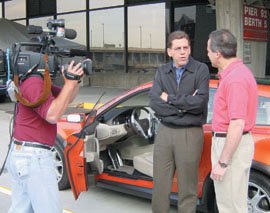 In all six markets, local affiliates of CBS, ABC, NBC, FOX and WB broadcast the story. Key national / international placements included: Next@CNN (an adapted version of the story also aired on CNN International), CNN Headline News (which ran the story nine times), CNN Airport News, Reuters Television, CNBC Squawk Box, CBS MarketWatch Weekend, Fox News, Tech TV. In all six markets, local affiliates of CBS, ABC, NBC, FOX and WB broadcast the story. Key national / international placements included: Next@CNN (an adapted version of the story also aired on CNN International), CNN Headline News (which ran the story nine times), CNN Airport News, Reuters Television, CNBC Squawk Box, CBS MarketWatch Weekend, Fox News, Tech TV.
In total, the story aired 299 times in the U.S., reaching an audience of over 33,000,000. The B-roll distribution, coupled with news feeds by FOX, CBS, NBC and ABC to their affiliates resulted in airings in an additional 87 markets beyond the six tour cities.
|